
La monitorización del OBERAXE logra con las plataformas un nuevo hito al superar el 62% de mensajes racistas eliminados en diciembre
23/01/2026
Monthly hate speech monitoring newsletter
The monitoring of the OBERAXE achieves with the platforms a new milestone by exceeding 62% of racist messages eliminated in December
Topics:

- The Observatory against Racism and Xenophobia (OBERAXE) reported 28,978 messages with hate speech to the platforms, the lowest figure of the year, which demonstrates the effectiveness of the anti-hate working group.
- The withdrawal rate is increased by 11 percentage points compared to the November bulletin, which notes a significant strengthening of the moderation and response mechanisms. TikTok, with 86%, is still the most effective, followed by X, which has withdrawn 67% of the reported messages
- “This is the result of intense work, day by day and hand by hand, with the different social networks”, said the director of OBERAXE, Tomás Fernández Villazala
Share on social networks:
The month of December has set a new record in the elimination of messages of racist and xenophobic content on social networks. During the last month of the year, the Spanish Monitoring Centre on Racism and Xenophobia (OBERAXE), under the State Secretariat for Migration of the Ministry of Inclusion, Social Security and Migration, recorded the highest rate of withdrawal of comments by getting platforms to delete 62% of the messages notified - compared to 51% that were deleted in November. Of these, 14% were withdrawn in the first 24 hours, while 38% were eliminated after being notified as a trusted flagger. This is clear from the hate speech monitoring data collected in the recently published December bulletin and carried out through the FARO (Social Media Hate Filtering and Analysis) system. During the month of December, five social networks were monitored: TikTok, X, Facebook, Instagram and Youtube. They detected 28,978 messages, a figure that brings to 808,176 the total number of messages detected throughout the year 2025. The data for the month of December also represents a significant decrease in relation to the messages detected in November, with 10,076 less detected comments compared to the previous month. As stated by the director of OBERAXE, Tomás Fernández Villazala, “this is the result of intense work on a daily basis, hand in hand with the different social networks”, while highlighting that “we have achieved a 62% withdrawal of messages, which helps us every day to achieve a fairer, respectful and multicultural society”. “And we continue to improve in the data every month, which makes us see that we are on the right path,” added Fernández Villazala.
TikTok the most effective platform in the withdrawal
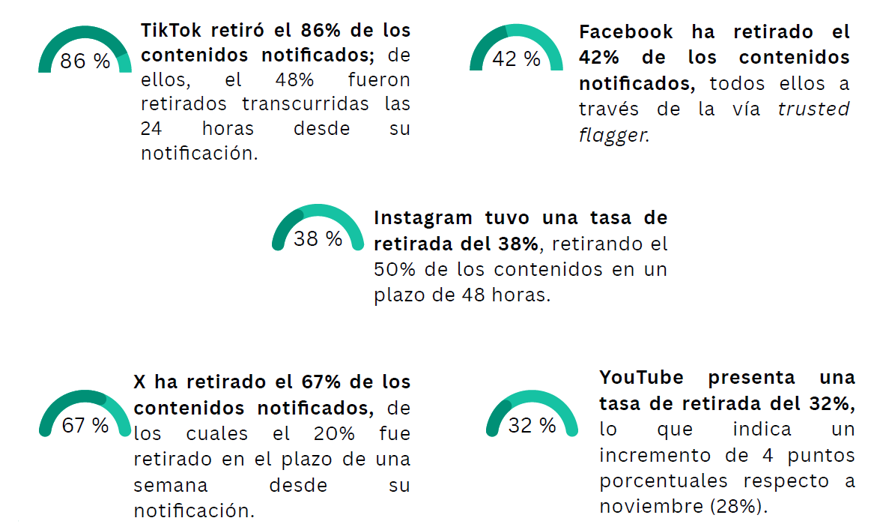
The TikTok platform continues to lead the fight against hate messages, since it continues to increase its withdrawal rate to 86% of the reported content, compared to 79% that it eliminated in November. It is followed by platform X, with an elimination percentage of 67%, Facebook with 42% of comments eliminated, Instagram, 38% and Youtube, with a 32% withdrawal of content reported.
Social networks withdrew 24% of the content reported as a normal user - not as a verifiable institution -, a figure that represents a notable increase compared to November, when the withdrawal by this route stood at 9%. In relation to the effectiveness period, 14% has been withdrawn in the first 24 hours, 4% in 48 hours and the remaining 6% during the first week after notification. This highlights differences in the effectiveness of the different verification channels, and demonstrates the need to strengthen moderation mechanisms and improve the effectiveness of reports made as normal, non-institutional users.
70% of content linked to people from North Africa
Hostility in December was once again concentrated in the target group of people from North Africa. Seventy per cent of the analysed contents were related to these people, a decrease of six percentage points compared to the previous month. In addition, the comments referring to Muslim people barely represent a variation with respect to the previous month with 18%. While Afro-descendants account for 9% of the messages linked to hate speech.
According to the type of content, the comments that dehumanize foreign people are still the most frequent, although they have experienced a significant decrease from 68% in November to 46% in December, but they are still the most frequent and contribute to the normalization of hostile attitudes. In addition, the percentage of messages that present the group of foreign people as a threat is doubled and promote the perception of these people as a danger since they reach 28% compared to 13% of the previous month. The messages that incite expulsion represent 14%, those that incite violence, 6% and those that praise those who promote hostile speeches represent 5%, all of them represent an increase of 3 points compared to the previous month, which implies an increase in hostile messages and legitimize violence against these people. In 92% of the messages the content is also explicit aggressive, which reflects high levels of hostility and contributes to social polarization. The episodes that most messages eliminated due to hatred were related mainly to citizen insecurity, with 57% of the total. This demonstrates the instrumentalization of citizen insecurity to reproduce xenophobic and racist narratives that consolidate stereotypes based on false data that end up impacting public opinion. Among the most frequent episodes are the armed conflict (20%) in relation to the war between Israel and Palestine, which was detonating comments with anti-Semitic and Islamophobic content with messages that justify violence. Also noteworthy in relation to terrorism (16%) are the messages of hatred removed after the attacks in Bondi Beach, in Australia. Regarding the economic sphere, which accounts for 14% of the messages detected, it is worth highlighting the hatred generated after the eviction in Badalona of a former secondary school in which 400 immigrants resided. Precisely to continue improving in the elimination of discourse in social networks, the working group for the elimination of hate discourse in social networks was launched that met on January 14 and in which both the platforms and the Secretary of State for Migration showed their predisposition to continue advancing in this way of the hand. A system that applies artificial intelligence, trained in LALIGA’s Monitor for Hate Watching in Sport (MOOD), to the methodology, specialization and experience accumulated by OBERAXE.